
Real estate data looks deceptively simple from the outside.
A property has a price, an address, a number of bedrooms, maybe a few photos and a listing date. Put all of that into a spreadsheet and you're done, right?
Not quite.
Once someone actually tries to collect property listings at scale, things get messy pretty quickly. Listings change, pages behave differently depending on location and repeated requests can trigger restrictions. A property portal might show one set of results to a visitor in New York and something slightly different to someone browsing from another state or country.
That's why the infrastructure behind a real estate scraper matters more than it might initially seem.
For anyone researching how to scrape real estate data in 2026, residential proxies are one of the areas worth paying attention to. They're particularly useful when the goal is to collect geographically relevant information rather than simply send as many requests as possible.
What I would want from a real estate scraper
If I were setting up a property-data project today, I'd look at four things first: location targeting, IP quality, session stability and the ability to scale.
Location targeting would probably come first.
I might need to collect listings from several cities, and I'd want the requests to originate from appropriate locations rather than one generic server somewhere halfway around the world. GoProxies, for example, documents country, city and state targeting for its residential network.
Then there's IP quality.
A scraper can be perfectly programmed and still have a miserable day if the proxy addresses repeatedly trigger restrictions. Residential IPs are useful here because they can make automated requests resemble traffic coming through ordinary ISP connections more closely than typical datacenter addresses.
That doesn't make a scraper invisible, of course. Websites can use many different signals. But the IP layer is still an important piece of the puzzle.
Residential proxies make a noticeable difference
This is probably the part I'd pay the most attention to when comparing providers.
There are plenty of big names in the proxy industry. Bright Data, Oxylabs and Smartproxy all have substantial infrastructure and are worth knowing about when researching the market.
But a real estate project doesn't necessarily need every possible proxy product under the sun.
What matters is whether the provider can deliver residential IPs in the locations the project actually needs and whether those connections remain useful when the workload grows.
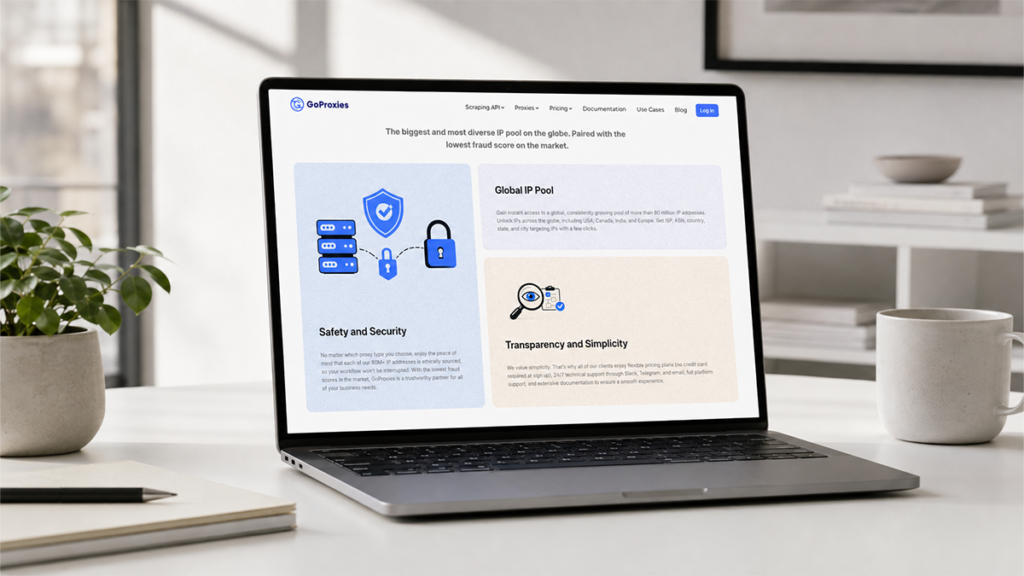
GoProxies has a particularly strong residential offering here. Its current network advertises more than 80 million IP addresses across 200+ locations, with country, city, state, ISP and ASN targeting available.
That's the sort of flexibility I'd find useful for property research.
Why? Because real estate is local. Very local.
Where a real estate scraper can be useful
There are plenty of legitimate reasons to collect publicly available property information.
An investment company might want to monitor asking prices across several markets. A property analyst could track changes in rental listings. A research team might compare inventory levels between cities.
Even something as straightforward as monitoring newly listed properties can involve a lot of repetitive work when done manually.
That's where a real estate scraper can save an enormous amount of time.
Instead of opening hundreds of listings every morning with a cup of coffee going cold beside the keyboard, structured data can be collected automatically and analysed in one place.
And if the project needs to scrape real estate websites across multiple markets, residential IPs can add another useful layer by allowing requests to be associated with different geographic locations.
Why I wouldn't automatically choose the biggest provider
This is where proxy comparisons can get a little silly.
One provider advertises millions of IPs. Another advertises even more. Then someone finds a third provider with an enormous list of locations and suddenly the comparison turns into a numbers competition.
But does a real estate project actually need the largest number?
Probably not.
I'd rather have reliable residential IPs in the specific cities and countries required by the project than a gigantic pool containing thousands of locations I'll never use.
That's also why GoProxies catches my attention in this particular use case. Its residential infrastructure is clearly positioned around geographic targeting and data collection, rather than treating residential IPs as just another checkbox on a huge product list. Its documentation also supports automatic rotation and sticky sessions, depending on the residential product being used.
The part people sometimes forget
There is one thing a proxy cannot fix: bad data collection logic.
If a website changes its page structure and the scraper doesn't notice, having ten million residential IPs won't magically repair the parser.
The same goes for duplicate listings, outdated prices or unclear data rights.
Residential proxies are infrastructure. They're an important part of the setup, but they're not the entire setup.
I'd therefore treat proxy selection as one layer of a larger system rather than expecting it to solve every scraping problem.
My overall take
For anyone building a real estate scraper in 2026, I'd put residential proxies fairly high on the checklist, particularly when geographic accuracy matters.
The property market is inherently local, and data collection should reflect that. Being able to target different countries, cities or states gives a scraping workflow much more flexibility than relying on a single datacenter location.
There are plenty of established competitors worth comparing, including Bright Data, Oxylabs and Smartproxy. But for a project where residential IP quality and geographic targeting are central, GoProxies has a particularly compelling setup, with a large residential pool and detailed location targeting.