

The Internet of Things market continues to grow rapidly, transforming industries from healthcare and manufacturing to logistics and smart buildings. Choosing the right IoT development partner is critical — the best companies can bring your connected product from concept to production, covering everything from embedded hardware and firmware to cloud platforms and mobile applications.
This article profiles seven leading IoT development companies recognized in 2025–2026 industry rankings, directories such as Clutch, IoT For All, and TechReviewer, and independent analyst reports. We also provide a practical framework to help you identify which type of partner best fits your project needs.
What Makes a Great IoT Development Company?
IoT projects span multiple technology layers: custom hardware and sensors, embedded firmware, connectivity protocols, cloud ingestion and device management, analytics and AI, and user-facing applications or dashboards. Most vendors specialize in a few of these layers, while a smaller group offers true end-to-end services.
When evaluating IoT development partners, consider these criteria:
- Clear and demonstrated focus on IoT, not just generic web or mobile development
- Portfolio of IoT projects across multiple industries
- Ability to deliver end-to-end solutions or deep expertise in a critical part of the stack
- Independent recognition in IoT-specific rankings and strong client feedback
- Relevant certifications and compliance with industry standards
Leading 7 IoT Development Companies in 2025–2026
As the Internet of Things continues to redefine the boundaries between physical hardware and digital intelligence, choosing a partner with deep technical expertise is essential for scaling smart ecosystems. These top-tier developers have distinguished themselves in the 2025–2026 market by delivering seamless integration across complex industrial and consumer environments.
The following list highlights the industry leaders currently driving innovation through robust connectivity and advanced
1. Softeq
Softeq is one of the most widely cited IoT and embedded engineering specialists, with over 26 years in the market. The company provides genuine end-to-end product development: custom hardware design, embedded systems, firmware, connectivity, cloud integration, and software, allowing clients to create complete IoT ecosystems under one roof.
Softeq is particularly strong in industrial automation, consumer electronics, wearables, and edge AI applications. Their engineers are experienced in working with microcontrollers, real-time operating systems, and low-power wireless protocols such as Zigbee, BLE, and LoRaWAN. The company has worked with global enterprises and startups alike, providing both full-product development and dedicated engineering team augmentation.
What sets Softeq apart is the combination of deep hardware competency and a mature software engineering practice, making it suitable for clients who need a single accountable partner across the entire product lifecycle. Their track record across sectors such as healthcare devices, industrial monitoring, and smart home technology makes them a strong candidate for complex, multi-layer IoT engagements.
2. Yalantis
Yalantis is an IT company founded in Ukraine in 2008 that has strategically positioned IoT as a core business focus. Approximately 40% of its projects are IoT-related, and that share continues to grow. To support end-to-end delivery, Yalantis operates an in-house R&D hardware lab in Warsaw covering the full hardware cycle: industrial design, electronics and PCB design, prototyping, testing, firmware, and embedded software.
The company’s comprehensive Internet of Things services encompass custom software development, embedded firmware, application building, and the seamless integration of various sensors and protocols. Yalantis excels at “bridging hardware and cloud,” delivering a unified ecosystem that scales from edge processing to cloud platforms, which significantly reduces technical complexity for its clients.
On Clutch, Yalantis is recognized as a distinguished IoT app development company, praised for complex integrations and 100% positive client feedback. IoT Tech Expo Europe lists the company as an end-to-end engineering partner with 500+ engineers, 40+ IoT deployments, ISO 9001/27001/27701 certifications, and an AWS partnership. Notable clients include Toyota Tsusho, Bosch, and KPMG. Core industry strengths span healthcare, logistics, manufacturing, automotive, and smart buildings.
3. SumatoSoft
SumatoSoft has been delivering IoT software since 2012 and appears consistently across “top IoT development companies” directories and independent review platforms. The company has built a reputation for industry-specific IoT solutions targeting healthcare, retail, manufacturing, smart homes and cities, and automotive sectors.
Their core offering focuses on custom IoT application development, enterprise IoT integration, and MVP development for connected products. SumatoSoft helps clients at various stages: from defining the IoT architecture and selecting the right connectivity stack to building scalable cloud backends and intuitive user-facing interfaces. Their healthcare IoT practice is particularly well-regarded, with experience in remote patient monitoring, smart medical devices, and compliance-driven development.
SumatoSoft is a good fit for companies seeking a mid-size development partner with a strong software focus and deep domain expertise in regulated industries. Their ability to deliver functional IoT MVPs quickly makes them appealing to product companies and startups looking to validate connected hardware concepts before scaling to production.
4. Oxagile
Oxagile brings over 17 years of experience and a client base of 450+ organizations to IoT development. The company is highlighted in major directories as a top IoT app development company, with particular strength in building software and prototypes for smart home systems, healthcare applications, EdTech platforms, and AI/ML-driven IoT scenarios.
Oxagile’s IoT practice sits within a broader technology portfolio that includes video processing, AI, and data engineering — making the company especially well-suited for IoT projects that involve video streaming (such as smart surveillance or connected camera systems), real-time analytics, and machine learning pipelines integrated with sensor data. Their engineers are experienced with cloud platforms including AWS IoT, Microsoft Azure IoT Hub, and Google Cloud IoT.
For clients whose IoT use cases intersect with media, AI, or advanced analytics, Oxagile offers a rare combination of domain depth and cross-disciplinary engineering capability. The company has successfully delivered projects for enterprises across North America and Europe, with consistent positive feedback around technical quality, communication, and delivery reliability.
5. Cogniteq
Cogniteq is a regional IoT specialist with offices in Poland, Lithuania, and the United States, profiled across multiple IoT review platforms as a company that delivers tailored IoT systems with strong embedded engineering competency. Their core focus areas include embedded solutions, wearable devices, connected applications, and IoT systems for healthcare and industrial organizations.
The company excels at hardware-adjacent engagements where firmware, RTOS, and device connectivity are as important as the cloud or mobile layer. Cogniteq has built a track record in medical IoT — a space that demands strict regulatory compliance, reliable device communication, and robust data security. Their industrial IoT practice covers predictive maintenance, asset tracking, and factory automation scenarios.
Cogniteq’s relatively focused team structure means clients typically get direct access to senior engineers rather than being managed through layers of project oversight. This makes the company a compelling option for organizations that want close collaboration, technical transparency, and a partner that can own complex, compliance-sensitive IoT deliverables from prototype through to field deployment.
6. Indeema
Indeema is a Clutch-listed IoT specialist whose portfolio combines IoT device development with web, mobile, AI, and product design capabilities. The company focuses primarily on IoT consulting, device development, cloud integration, and connected product enablement for SMEs and mid-market clients across Europe and North America.
Indeema’s approach emphasizes rapid prototyping and iterative product development, making them a practical choice for companies that are still defining the architecture of their connected product. The company has delivered projects in smart home automation, industrial monitoring, energy management, and asset tracking, with consistent praise for its flexibility and ability to adapt to evolving product requirements.
Their integrated practice — spanning IoT hardware consulting, embedded software, mobile app development, and cloud backend — allows clients to engage Indeema as a single partner for connected product development without sourcing hardware and software capabilities from separate vendors. This integration reduces coordination overhead and helps maintain consistency across the IoT product stack.
7. Matellio
Matellio is an IoT development company with a strong end-to-end portfolio spanning healthcare, logistics, agriculture, consumer IoT, and smart home applications. The company is highlighted across several IoT directories for its ability to deliver complete connected product solutions, from device firmware through to enterprise-grade cloud platforms and mobile interfaces.
Matellio offers IoT consulting, product design, embedded firmware development, IoT platform integration (including AWS IoT, Azure, and Google Cloud), and custom dashboard development. Their logistics and supply chain IoT practice — covering GPS tracking, cold-chain monitoring, and fleet telematics — is particularly noted in client reviews and case studies.
The company operates across time zones with delivery teams in India and client-facing operations in North America and Europe, providing cost-effective IoT development without sacrificing technical depth. Matellio is well-suited to companies seeking a scalable development partner that can grow alongside a connected product from MVP through enterprise deployment, particularly for asset-intensive industries where real-time tracking and condition monitoring are core requirements.
How to Choose the Right IoT Development Company
Selecting an IoT partner is not a one-size-fits-all decision. The right choice depends on the nature of your project, your team’s internal capabilities, and how much of the IoT stack you need an external partner to own.
Match the Partner to Your Project Type
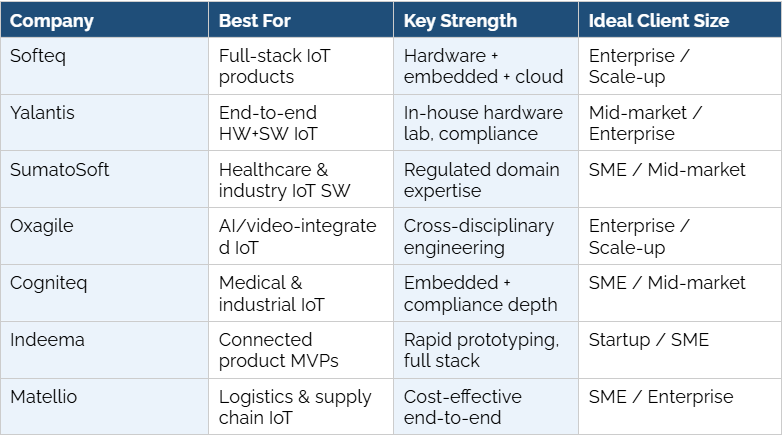
- Hardware-first projects (custom sensors, PCB design, enclosures): Look for companies with in-house hardware labs and embedded engineering depth — Softeq, Yalantis, and Cogniteq are strong candidates.
- Software and cloud-centric IoT: If the hardware is off-the-shelf and your challenge is data ingestion, analytics, or application development, Oxagile, SumatoSoft, or Indeema may offer a better fit.
- Regulated industries (healthcare, automotive, manufacturing): Prioritize partners with relevant certifications (ISO 9001, ISO 27001) and proven experience in compliance-driven environments — Yalantis and Cogniteq stand out here.
- Large-scale enterprise deployments: Global system integrators such as EPAM and Bosch Global Software Technologies offer greater scale, though typically at higher cost and with less flexibility.
Key Questions to Ask Before Shortlisting
- Does the company have a dedicated hardware team, or do they rely on third-party hardware partners?
- Can they show reference deployments in your industry with measurable outcomes?
- What IoT cloud platforms do they work with, and do they have partnerships with AWS, Azure, or Google Cloud?
- How do they handle security and compliance requirements specific to your sector?
- What is their typical team size for engagements similar to yours, and how is the team structured?
Quick Selection Guide by Company Size and Need
Final Thoughts
The IoT development landscape in 2025–2026 is rich with capable partners, but the best choice depends heavily on your specific project requirements. Whether you need a partner that can design custom hardware from scratch, integrate an existing device into a scalable cloud platform, or build a compliance-grade medical IoT product, there is a specialist in this list suited to your needs.
Start by defining which layers of the IoT stack you need external expertise for, identify two or three companies whose portfolios align with your industry, and use the questions above to evaluate fit before committing to a partnership. A thorough vendor assessment up front will save significant time and cost during development and scaling.